


Mae pobl wedi defnyddio pibellau ers miloedd o flynyddoedd. Efallai mai'r defnydd cyntaf oedd gan amaethwyr hynafol a ddargyfeiriodd ddŵr o nentydd ac afonydd i'w caeau. Mae tystiolaeth archeolegol yn awgrymu bod y Tsieineaid wedi defnyddio pibell cyrs ar gyfer cludo dŵr i leoliadau a ddymunir mor gynnar â 2000 0010010 nbsp;B.C. & nbsp;Clay tubes that were used by other ancient civilizations have been discovered. During the first century & nbsp;A.D. & nbsp;, the first lead pipes were constructed in Europe. In tropical countries, bamboo tubes were used to transport water. Colonial Americans used wood for a similar purpose. In 1652, the first waterworks was made in Boston using hollow logs.
Development of the modern day welded steel pipe can be traced back to the early 1800s. In 1815, William Murdock invented a coal burning lamp system. To fit the entire city of London with these lights, Murdock joined together the barrels from discarded muskets. He used this continuous pipeline to transport the coal gas. When his lighting system proved successful a greater demand was created for long metal tubes. To produce enough tubes to meet this demand, a variety of inventors set to work on developing new pipe making processes.
An early notable method for producing metal tubes quickly and inexpensively was patented by James Russell in 1824. In his method, tubes were created by joining together opposite edges of a flat iron strip. The metal was first heated until it was malleable. Using a drop hammer, the edges folded together and welded. The pipe was finished by passing it through a groove and rolling mill.
Ni ddefnyddiwyd dull Russell & # 39; s yn hir oherwydd yn y flwyddyn nesaf, datblygodd Comelius Whitehouse ddull gwell ar gyfer gwneud tiwbiau metel. Y broses hon, a elwir yn broses weldio casgen - yw'r sylfaen ar gyfer ein gweithdrefnau gwneud pibell - cyfredol. Yn ei ddull, cynheswyd a thynnwyd dalennau tenau o haearn trwy agoriad siâp côn -. Wrth i'r metel fynd trwy'r agoriad, cyrliodd ei ymylon i fyny a chreu siâp pibell. Cafodd y ddau ben eu weldio gyda'i gilydd i orffen y bibell. Y ffatri weithgynhyrchu gyntaf i'w defnyddio
this process in the United States was opened in 1832 in Philadelphia.
Gradually, improvements were made in the Whitehouse method. One of the most important innovations was introduced by John Moon in 1911. He suggested the continuous process method in which a manufacturing plant could produce pipe in an unending stream. He built machinery for this specific purpose and many pipe manufacturing facilities adopted it.
While the welded tube processes were being developed, a need for seamless metal pipes arouse. Seamless pipes are those which do not have a welded seam. They were first made by drilling a hole through the center of a solid cylinder. This method was developed during the late 1800s. These types of pipes were perfect for bicycle frames because they have thin walls, are lightweight but are strong. In 1895, the first plant to produce seamless tubes was built. As bicycle manufacturing gave way to auto manufacturing, seamless tubes were still needed for gasoline and oil lines. This demand was made even greater as larger oil deposits were found.
As early as 1840, ironworkers could already produce seamless tubes. In one method, a hole was drilled through a solid metal, round billet. The billet was then heated and drawn through a series of dies which elongated it to form a pipe. This method was inefficient because it was difficult to drill the hole in the center. This resulted in an uneven pipe with one side being thicker than the other. In 1888, an improved method was awarded a patent. In this process the solid billed was cast around a fireproof brick core. When it was cooled, the brick was removed leaving a hole in the middle. Since then new roller techniques have replaced these methods.
Dylunio
Mae dau fath o bibell ddur, mae un yn ddi-dor ac mae gan un arall wythïen wedi'i weldio ar ei hyd. Mae gan y ddau ddefnydd gwahanol. Mae tiwbiau di-dor fel arfer yn fwy o bwysau ysgafn, ac mae ganddyn nhw waliau teneuach. Fe'u defnyddir ar gyfer beiciau a chludo hylifau. Mae tiwbiau wedi'u selio yn drymach ac yn fwy anhyblyg. Mae ganddyn nhw well cysondeb ac maen nhw'n nodweddiadol yn sythach. Fe'u defnyddir ar gyfer pethau fel cludo nwy, cwndid trydanol a phlymio. Yn nodweddiadol, fe'u defnyddir mewn achosion pan nad yw'r bibell yn cael ei rhoi o dan lefel uchel o straen.
Certain pipe characteristics can be controlled during production. For example, the diameter of the pipe is often modified depending how it will be used. The diameter can range from tiny pipes used to make hypodermic needles, to large pipes used to transport gas throughout a city. The wall thickness of the pipe can also be controlled. Often the type of steel will also have an impact on pipe & #39;s the strength and flexibility. Other controllable characteristics include length, coating material, and end finish.
Deunyddiau Crai
Y prif ddeunydd crai wrth gynhyrchu pibellau yw dur. Mae dur yn cynnwys haearn yn bennaf. Mae metelau eraill a allai fod yn bresennol yn yr aloi yn cynnwys alwminiwm, manganîs, titaniwm, twngsten, vanadium a zirconium. Weithiau defnyddir rhai deunyddiau gorffen wrth gynhyrchu. Er enghraifft, gall paent fod
yn cael ei ddefnyddio os yw'r bibell wedi'i gorchuddio. Yn nodweddiadol, rhoddir ychydig bach o olew ar bibellau dur ar ddiwedd y llinell gynhyrchu. Mae hyn yn helpu i amddiffyn y bibell. Er nad yw'n rhan o'r cynnyrch gorffenedig mewn gwirionedd, defnyddir asid sylffwrig mewn un cam gweithgynhyrchu i lanhau'r bibell.
Y Gweithgynhyrchu
Proses
Steel pipes are made by two different processes. The overall production method for both processes involves three steps. First, raw steel is converted into a more workable form. Next, the pipe is formed on a continuous or semicontinuous production line. Finally, the pipe is cut and modified to meet the customer & #39;s needs.
Cynhyrchu inc
1 Gwneir dur tawdd trwy doddi mwyn haearn a golosg (sylwedd cyfoethog carbon - sy'n arwain pan fydd glo yn cael ei gynhesu yn absenoldeb aer) mewn ffwrnais, yna tynnu'r rhan fwyaf o'r carbon trwy ffrwydro ocsigen i'r hylif. Yna caiff y dur tawdd ei dywallt i fowldiau haearn muriog mawr, trwchus -, lle mae'n oeri yn ingotau.
2 In order to form flat products such as plates and sheets, or long products such as bars and rods, ingots are shaped between large rollers under enormous pressure.
Cynhyrchu blodau a slabiau
3 Er mwyn cynhyrchu blodeuo, mae'r ingot yn cael ei basio trwy bâr o rholeri dur rhigol sy'n cael eu pentyrru. Gelwir y mathau hyn o rholeri yn & quot; dwy felin - uchel. Quot & ; Mewn rhai achosion, defnyddir tri rholer. Mae'r rholeri wedi'u mowntio fel bod eu rhigolau yn cyd-daro, ac maen nhw'n symud i gyfeiriadau gwahanol. Mae'r weithred hon yn achosi i'r dur gael ei wasgu a'i ymestyn yn ddarnau teneuach, hirach. Pan fydd y rholeri'n cael eu gwrthdroi gan y gweithredwr dynol, mae'r dur yn cael ei dynnu yn ôl trwy ei wneud yn deneuach ac yn hirach. Ailadroddir y broses hon nes bod y dur yn cyflawni'r siâp a ddymunir. Yn ystod y broses hon, mae peiriannau o'r enw manipulators yn fflipio'r dur fel bod pob ochr yn cael ei brosesu'n gyfartal.
4 Ingots may also be rolled into slabs in a process that is similar to the bloom making process. The steel is passed through a pair of stacked rollers which stretch it. However, there are also rollers mounted on the side to control the width of the slabs. When the steel acquires the desired shape, the uneven ends are cut off and the slabs or blooms are cut into shorter pieces.
Prosesu pellach
5 Blooms are typically processed further before they are made into pipes. Blooms are converted into billets by putting them through more rolling devices which make them longer and more narrow. The billets are cut by devices known as flying shears. These are a pair of synchronized shears that race along with the moving billet and cut it. This allows efficient cuts without stopping the manufacturing process. These billets are stacked and will eventually become seamless pipe.
6 Slabs are also reworked. To make them malleable, they are first heated to 2,200° F (1,204° C). This causes an oxide coating to form on the surface of the slab. This coating is broken off with a scale breaker and high pressure water spray. The slabs are then sent through a series of rollers on a hot mill and made into thin narrow strips of steel called skelp. This mill can be as long as a half mile. As the slabs pass through the rollers, they become thinner and longer. In the course of about three minutes a single slab can be converted from a 6 in (15.2 cm) thick piece of steel to a thin steel ribbon that can be a quarter mile long.
7 After stretching, the steel is pickled. This process involves running it through a series of tanks that contain sulfuric acid to clean the metal. To finish, it is rinsed with cold and hot water, dried and then rolled up on large spools and packaged for transport to a pipe making facility.
Gwneud pibellau
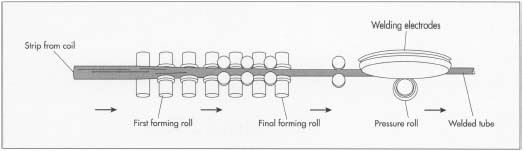
8 Both skelp and billets are used to make pipes. Skelp is made into welded pipe. It is first placed on an unwinding machine. As the spool of steel is unwound, it is heated. The steel is then passed through a series of grooved rollers. As it passes by, the rollers cause the edges of the skelp to curl together. This forms an unwelded pipe.
9 The steel next passes by welding electrodes. These devices seal the two ends of the pipe together. The welded seam is then passed through a high pressure roller which helps create a tight weld. The pipe is then cut to a desired length and stacked for further processing. Welded steel pipe is a continuous process and depending on the size of the pipe, it can be made as fast as 1,100 ft (335.3 m) per minute.
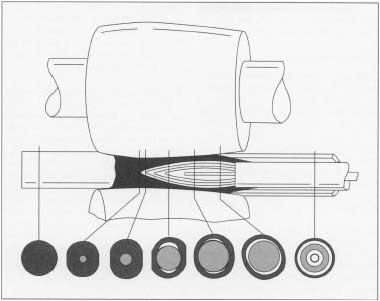
10 Pan fydd angen pibell ddi-dor, defnyddir biledau sgwâr i'w cynhyrchu. Maent yn cael eu cynhesu a'u mowldio i ffurfio siâp silindr, a elwir hefyd yn rownd. Yna rhoddir y rownd mewn ffwrnais lle caiff ei gynhesu'n wyn - poeth. Yna caiff y rownd wedi'i gynhesu ei rolio â phwysau mawr. Mae'r rholio pwysedd uchel hwn yn achosi i'r biled ymestyn allan a thwll i ffurfio yn y canol. Gan fod y twll hwn wedi'i siapio'n afreolaidd, mae pwynt tyllwr siâp bwled yn cael ei wthio trwy ganol y biled wrth iddo gael ei rolio. Ar ôl y cam tyllu, gall y bibell fod o drwch a siâp afreolaidd o hyd. I gywiro hyn, caiff ei basio trwy gyfres arall o felinau rholio.
Prosesu terfynol
11 After either type of pipe is made, they may be put through a straightening machine. They may also be fitted with joints so two or more pieces of pipe can be connected. The most common type of joint for pipes with smaller diameters is threading—tight grooves that are cut into the end of the pipe. The pipes are also sent through a measuring machine. This information along with other quality control data is automatically stenciled on the pipe. The pipe is then sprayed with a light coating of protective oil. Most pipe is typically treated to prevent it from rusting. This is done by galvanizing it or giving it a coating of zinc. Depending on the use of the pipe, other paints or coatings may be used.


